
Solve for x, 3x = 2x
x = 0
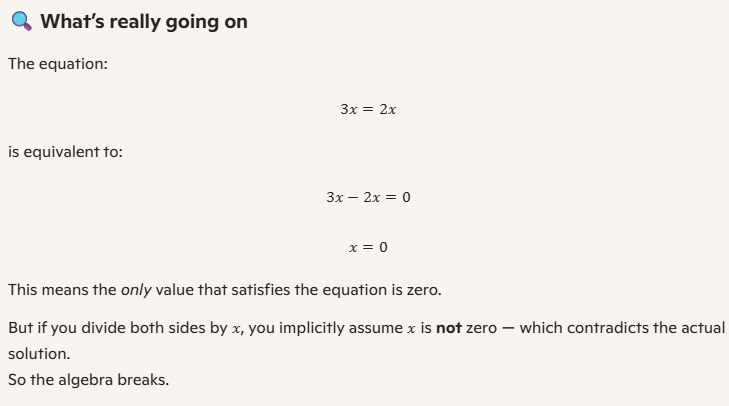
On the face of it, the only possible solution to the equation is zero.
3 x 0 and 2 x 0 are both zero.
Any other value for x is impossible.
Using Algebra
In maths, algebraic equations require us to rearrange them so that x is on one side. One way to do this is to divide both sides by x. This leads to:
Now, any number divided by itself is 1, but: 1.5 <> 1.
Can x be 0?
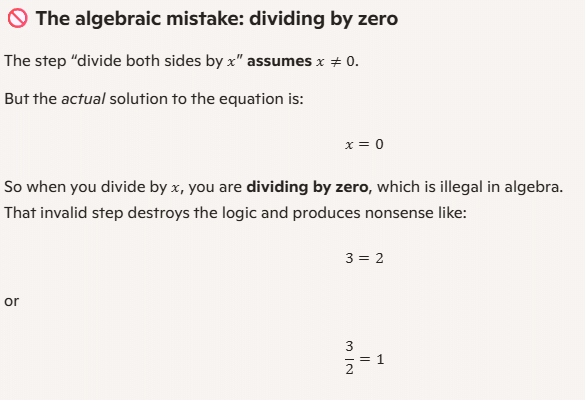
The trouble is if x was zero,
The above cannot be defined because any division by zero is undefined in mathematics.
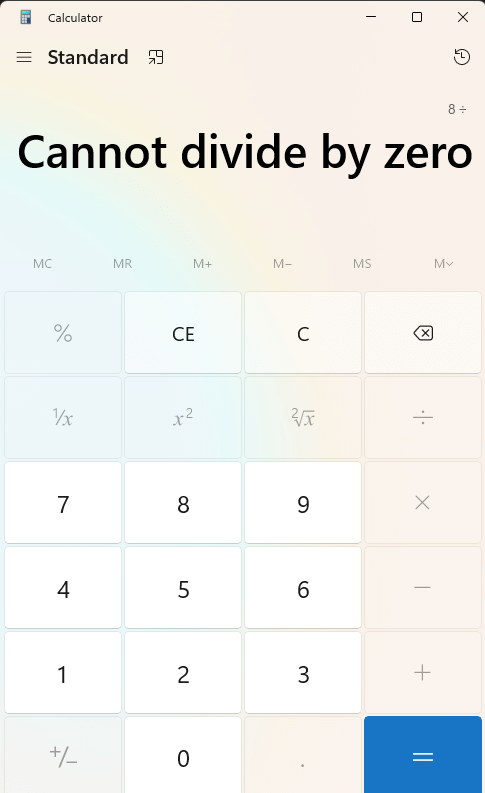
If you divide any number by zero on a calculator, it returns an error.
What does AI think?


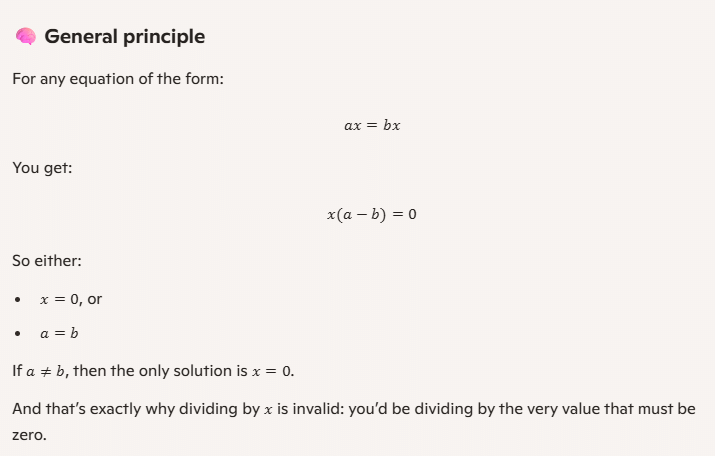
To Consider
- Has AI solved the puzzle algorithmically or using probability?
- Has AI explained its solution by retrieving a stock answer or using probability?
1. Has AI solved the puzzle algorithmically or using probability?
Short answer: It solved it algorithmically, not probabilistically.
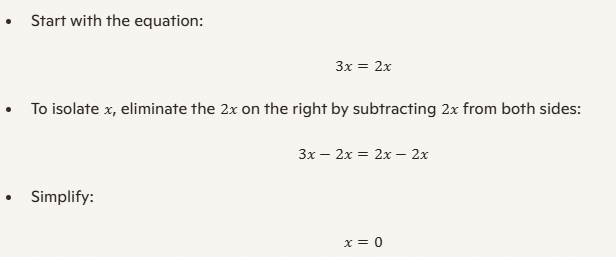
Why: The equation 3x = 2x is a deterministic algebra problem. There is only one mathematically valid manipulation:
This is pure symbolic algebra. There is no statistical inference, no pattern‑matching, no probability distribution involved.
Even though LLMs internally operate using probability, when the task is a well‑defined algebraic manipulation, the model follows the learned algorithmic pattern for solving linear equations:
- isolate terms
- subtract like terms
- solve for the variable
This is not “guessing the next word” in a probabilistic sense; it is reproducing the correct algebraic procedure because that procedure is strongly encoded in its training.
So:
The puzzle itself is solved algorithmically.
2. Has AI explained its solution by retrieving a stock answer or using probability?
Short answer: It explained the solution using probability‑driven pattern generation, not by retrieving a stored answer.
Why: LLMs do not store fixed answers or templates. They don’t have a “stock response” for “3x = 2x”.
Instead, they generate each sentence by predicting the next token based on:
- mathematical patterns learned during training
- the structure of your question
- the style you previously asked for
- the conversational context
So the explanation is produced probabilistically — but guided by the strong mathematical patterns the model has learned.
This is why:
- the algebra is correct
- the explanation is tailored to your phrasing
- the style matches the refined version you asked for yesterday
It’s not retrieval. It’s probabilistic generation constrained by learned mathematical rules.
So:
The explanation is generated probabilistically, not retrieved.
J K Mullins
The Book Hook Online
October 4, 2026
Further Reading
- How We Got to Modern AI and What It Really Means
- My AI Summary
- Oxford University – Is AI as clever as it looks?
Explore our creative collections on Etsy – inspired by the stories you love.

Leave a Reply