
Molly George
Author of “The Lies Love Hides” – Interviewed on 27th August 2026.
Molly, please introduce yourself to our readers.
I’m Molly George, an author from the south of England. I’m also a mum and a trauma-informed counsellor, with a particular interest in abuse, trauma, healing and the process of finding yourself again after difficult experiences.
Outside of writing and counselling, I love travelling and exploring new places, anything a little spiritual, being creative, and spending time with the people I love. I’m naturally curious about people and what shapes us, and I’m fascinated by the way we can heal, grow and rediscover parts of ourselves that perhaps became lost along the way.
Writing has become a much bigger part of my life than I ever expected it to. What began as something very personal has gradually grown into something much wider, and I’m really enjoying seeing where that journey takes me.
Have you always had an interest in poetry in particular, or writing in general?
I’ve always had a love of writing. As a child, I would write poems and short stories, so I think that creative part of me was always there, although somewhere along the way life took over and I moved away from it.
It was actually through my own healing that I found my way back to writing again. I began using words as a way of processing things I had experienced and emotions that were sometimes difficult to make sense of. There was something incredibly cathartic about taking what was going on inside me and putting it onto a page, almost as though once the words were out, I didn’t have to carry them in quite the same way.
Poetry in particular gave me the freedom to say a lot with very few words. It became a release, but also a way of understanding my own experiences differently. And as my healing progressed, the poems began to reflect that too. They don’t only hold the pain or what happened; they also hold the aftermath, the rebuilding, the return to myself and, eventually, the strength that came from it.
Looking back at some of those poems now is a powerful reminder of how far I’ve come. I can see the person I was when I wrote them, but I can also see the person I was becoming. In that sense, the poems have almost become markers along my own healing journey.
I don’t think I consciously decided to become a writer again; I think writing simply became part of how I healed.
What were your motivations for writing “The Lies Love Hides”?
The motivation actually changed over time. I didn’t originally sit down with the intention of writing a book. Many of the poems began simply as a way for me to process my own experiences and healing. They were never really written with an audience in mind.
As time passed, though, I began to realise that the things I was writing about weren’t only about me. So many experiences of abuse can be incredibly difficult to put into words, particularly when you are still living within them. Sometimes there isn’t one enormous moment that tells you something is wrong; it can be the accumulation of smaller things, the confusion, the self-doubt, the gradual loss of yourself and the things you slowly learn to accept as normal.
That became a huge motivation for turning the poems into The Lies Love Hides. I wanted to put words around some of those experiences, but I also wanted the book to show what can exist beyond them. The poems move through different stages, from love and confusion, through abuse and its aftermath, and eventually towards healing, reclaiming yourself and finding your own voice again.
I think there is enormous power in recognising yourself in somebody else’s words. If someone reads one of these poems and thinks, “That’s how I feel. I just didn’t know how to say it,” then perhaps they may feel a little less alone. And if another person reaches the later poems and sees that there can be a life, and even hope on the other side, then that means an incredible amount to me.
Ultimately, I think that became my biggest motivation: taking something that once caused pain and turning it into something that might help someone else.
How much of this is based on your personal experience?
All of it. The experiences and emotions behind the poems are very personal to me and come from things I have lived through at different points in my life.
What changed over time was my understanding of those experiences. As I began my own healing and later followed my path into counselling, I gained a much deeper understanding of abuse, trauma and the impact they can have on the way we see ourselves, our relationships and even our own reality.
That knowledge gave me language for things I hadn’t necessarily had words for when I was living through them. I could look back with a different understanding and recognise patterns, behaviours and dynamics that I simply couldn’t see clearly from inside the experience.
I think that combination of lived experience and what I have learned through healing and counselling has really shaped the book. The emotions within the poems belong to the person who lived them, but there is also the perspective of the person who came through them and can now look back with greater understanding.
In many ways, The Lies Love Hides holds both versions of me, the woman who was trying to understand what was happening to her, and the woman who eventually did.
Did you find the process of writing the book difficult and time consuming?
Yes and no. The book itself was written over many years, throughout my own healing, rather than being something I sat down and decided to write from beginning to end. As different memories, emotions or realisations surfaced, I would often process them through writing. At the time, I used to call it “healing with words.”
There were certainly difficult moments. Writing could bring painful memories back to the surface, and sometimes putting something into words meant really allowing myself to acknowledge what had happened and how it had affected me. That wasn’t always easy.
But ultimately, writing helped me heal. It gave me somewhere to put those feelings rather than continuing to carry them, and over the years the words changed as I changed. Some were written from within the pain, others from the aftermath, and later ones came from a place of understanding, strength and reclaiming myself.
So, although The Lies Love Hides took many years to write, I never really experienced those years as “writing a book.” I was healing, and I was writing my way through it. The book came afterwards.
What are you hopes for those reading the book, for both those who maybe are experiencing their own difficulties and for more general readers?
More than anything, I hope the book offers exactly that, HOPE.
For someone who is experiencing abuse, or beginning to question what they are experiencing, I hope it gives words to things they may not yet have the vocabulary for. Abuse can leave you confused and doubting your own perception of what is happening, and sometimes seeing your experience reflected in somebody else’s words can be incredibly powerful. I want someone reading it to feel seen and heard, perhaps for the first time, and to realise that they are not alone.
For those who have already left, I hope the later poems offer something different; recognition of the aftermath, but also hope for what can come beyond it. Healing isn’t necessarily about returning to the person you were before. Sometimes it is about discovering who you are now, reclaiming your voice and slowly building a life that feels like your own again.
For general readers, I hope the book creates greater understanding and awareness of abuse. We don’t have to have personally experienced abuse to benefit from being educated about it. The more we understand what abuse actually looks and feels like, the better equipped we are to recognise it and to support somebody who may be living through it or recovering from it.
I also hope it helps people understand that leaving an abusive relationship is not simply another kind of break-up. The emotional and psychological impact can continue long after the relationship itself has ended, and healing from that can be complex. Sometimes the greatest thing we can offer another person is not advice or judgement but empathy and understanding.
If this book helps someone recognise their own experience, feel less alone, find hope in their healing, or simply understand another person’s experience with a little more compassion, then it has done what I hoped it would do.
Is there one poem that you feel closest to or offers a standout message for others?
That is such a difficult question because different poems mean different things to me, but if I had to choose one, it would probably be THANK YOU – A POEM TO MY NARCISSIST.
It was actually the very first poem I wrote as part of my healing, and yet it became the final poem in the book, which feels quite significant to me now. It almost unintentionally created a full circle.
The title can sound surprising, because I am certainly not thanking someone for abuse or suggesting that we need to be grateful for the things that hurt us. For me, it is about what I chose to do with what happened afterwards. I couldn’t change the experiences I had been through, but I could decide that they would not be the end of my story.
That poem represents taking something that had once taken so much from me and recognising what I had reclaimed; my voice, my boundaries, my understanding of myself and ultimately my power.
There are poems within the book that may be more raw or that perhaps resonate more strongly with individual readers, but that one holds something very personal for me. It was one of the first times I put my healing into words, and now it closes the book.
I rather love that the first poem I wrote became the last word.
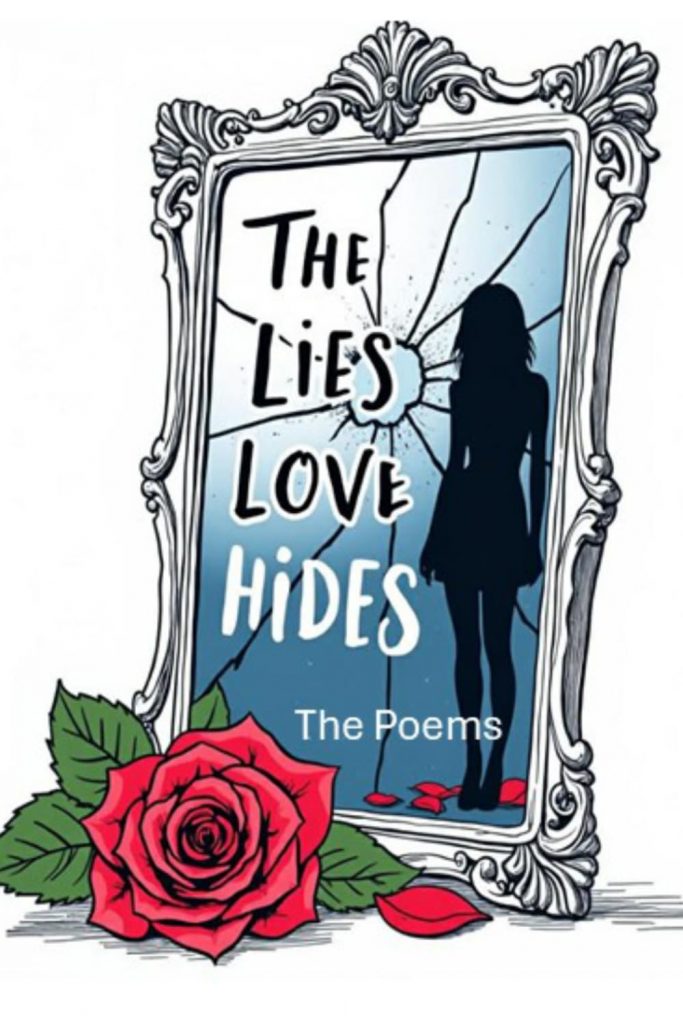
I found the cover of the book very striking, how did you come up with the idea?
Thank you! Then I think the cover has done exactly what I hoped it would!
I knew from the beginning that I wanted it to be striking. I didn’t want something that softened the subject matter or hid behind a beautiful image. I wanted someone to look at it and feel something before they had even opened the book.
The imagery is very deliberate. The mirror represents perception; the idea that what we see, or what other people see from the outside, is not always the reality of what is happening behind closed doors. It also reflects the way abuse can distort how we see ourselves and leave us questioning our own reality.
The roses represent love and everything we associate with it; romance, beauty, tenderness and the promise of something wonderful. But that sits alongside the shattered glass, because The Lies Love Hides is also about those illusions breaking apart as you begin to see what was really there.
I wanted the cover to capture the whole journey of the book in one image: love, illusion, fractured reality and ultimately the moment when you begin to see clearly.
It isn’t supposed to be a comfortable cover. Because neither is the subject.
Apart from the emotional journey that writing this book took you on, what have you found challenging as a self-published author?
I have very quickly discovered that writing the book may actually have been the easier part!
I came into self-publishing with absolutely no background in publishing or marketing, and suddenly there was this whole new world to navigate: formatting, distribution, ISBNs, pricing, websites, social media, promotion and trying to work out how on earth you actually get a book into the hands of the people who might want to read it. It has been a bit of a minefield at times.
Marketing in particular has probably been my biggest challenge. I’m not marketing-trained and, if I’m completely honest, I’ve mostly been feeling my way through it, seeing what I’m drawn towards and trusting my gut about which opportunities feel right.
There feels like an enormous amount of noise around self-publishing. Everyone seems to have an opinion about what you must be doing, alongside endless offers of services that promise to make your book successful. Learning to filter through all of that, trust my own judgement and remember why I published the book in the first place has probably been one of the biggest lessons.
At the same time, there is something quite exciting about not having had a set plan. I’ve submitted pieces when an opportunity has caught my attention, reached out to people when it felt right and generally just allowed myself to see where it takes me. That approach has already led to some lovely and completely unexpected opportunities, including having my poetry and writing published by a magazine.
I certainly didn’t expect that when I first decided to put the book out into the world. So, although self-publishing has been a huge learning curve, it has also taught me to be brave enough to put my work forward, trust it a little more, and see what happens.
I am absolutely still learning as I go, and perhaps that is part of the adventure.
What comes next for Molly?
This is probably the most exciting question because there is so much I want to do, and I’m also quite happy not knowing exactly where all of this will lead.
The Lies Love Hides is already beginning to grow beyond the book. I’ve created a website where I can continue writing about abuse, trauma and healing, share resources and hopefully create a space where people can find understanding, recognition and hope. I’m also continuing to write and submit poetry and other pieces for publication, which has already opened some doors I never expected.
But perhaps the thing I’m most excited about is the next book.
I’m currently writing The Counsellor in the Room – Inside The Lies Love Hides: The Story Behind the Poems. In it, I return to the experiences behind many of the poems, but this time I’m able to bring everything I have since learned through my own healing and my work as a trauma-informed counsellor into the room with me.
I’m essentially going back into those experiences and unpicking them, looking at what was happening beneath the surface, recognising the abuse and its impact with the understanding I simply didn’t have while I was living it, and finally being able to name behaviours and dynamics that can be incredibly difficult to recognise when you are inside them.
But just as importantly, I want to show how healing actually happens. Not as a perfectly ordered journey where one day you decide to heal and everything gets progressively better, but authentically, with the realisations, setbacks, grief, anger, questioning, rebuilding and those moments when you suddenly realise just how far you have come.
The poetry gave me a way to express what those experiences felt like. This next book gives me the opportunity to go behind those words and understand them.
After that? I genuinely don’t know, and I think that might be part of the excitement. I’m going to keep writing, keep using my voice and keep following where this takes me.
Discover more
- You can find out more about Molly George, her writing and The Lies Love Hides at: https://thelieslovehides.co.uk
- Amazon universal purchase link for The Lies Love Hides.
Further reading
- An interview with Grace Main, author of Estranged Lives.
- An interview with poet Erica Ma.
- An interview with poet Lyra Wilder.
- Free Poetry