
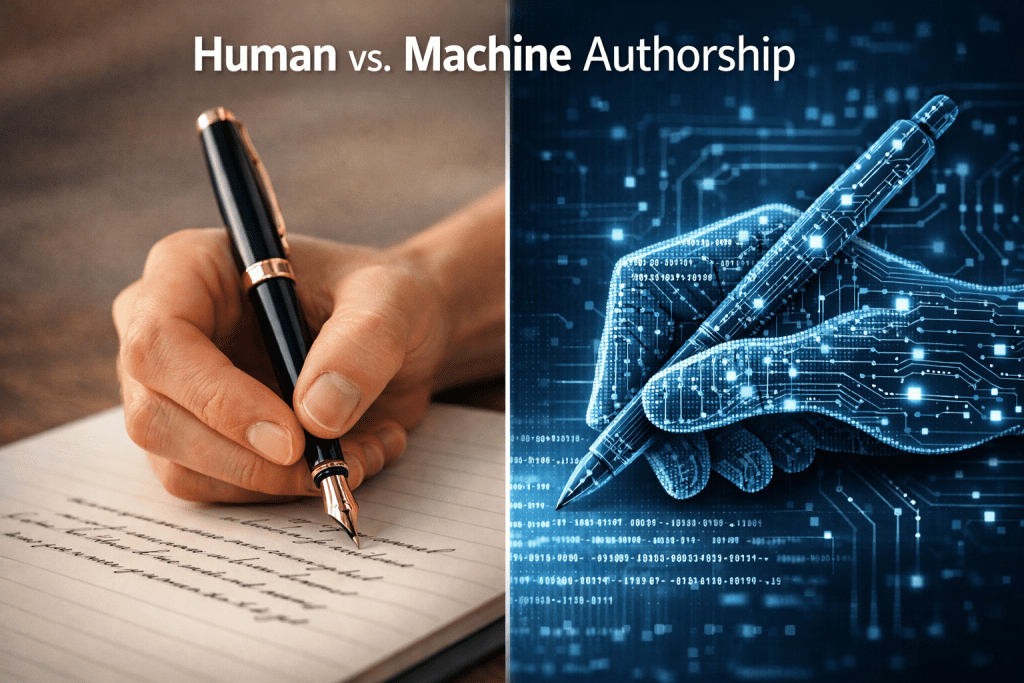
Artificial intelligence has become one of the most debated concepts of our time, but is AI real? We talk about AI as if it’s a new kind of mind, a digital consciousness emerging from code. But when you strip away the hype, a more grounded truth appears:
AI is not an independent entity. AI is a human creation. And everything it produces is downstream of human input.
This raises an important question: If AI is fundamentally human‑dependent, what does that mean for the tools designed to detect it?
Let’s explore the idea step by step.
1. AI Is Built on Human Intelligence
Despite the name, artificial intelligence is not “intelligence” in the human sense. It doesn’t think, feel, or understand. It processes patterns.
But those patterns come from us.
- Humans write the training data
- Humans design the models
- Humans validate the outputs
- Humans decide what “good” looks like
AI is not a mind. It’s a mirror, reflecting the structure of human language, human ideas, and human behaviour.
Without human input, AI simply wouldn’t exist. So, does this answer the question, is AI real?
2. The Bible Example Shows How Complex Authorship Really Is
Recently, some AI detectors suggested that parts of the Bible were “likely written by AI.” This is a provocative claim, but it highlights something deeper: authorship is not always straightforward.
For centuries, people have debated who wrote the Bible:
- Some believe it was written by God, with humans acting as the instrument.
- Others believe it was written by ancient philosophers, historians, and storytellers.
- Some see it as a layered text shaped by many hands over many generations.
Different interpretations, but one constant:
Humans are always involved.
Even in religious explanations, humans are the medium through which the text emerges.
This matters because it shows how difficult it is to cleanly separate “human‑written” from “other‑written.” Authorship is often collaborative, layered, and influenced by forces beyond the individual writer.
3. AI Writing Is Also Human Writing, Just Processed Differently
When AI generates text, it isn’t creating something from nothing. It’s reorganising human‑written material into new patterns.
In that sense:
- AI writing is human writing, filtered through a machine
- AI style is human style, recombined
- AI “voice” is a statistical echo of human voices
So when we ask whether a piece of text is “AI‑written,” we’re really asking:
How much human influence is too much human influence?
And that’s not a question with a clean answer.
4. The Problem With AI Detectors
AI detectors claim to identify whether text was written by a human or a machine. But detectors themselves are:
- trained by humans
- built on human assumptions
- limited by human biases
- validated by human judgement
This creates a paradox:
We’re using human‑made tools to detect human‑influenced outputs.
Detectors often mislabel:
- human writing as AI
- AI writing as human
- or both, depending on the model
They are not measuring intelligence. They are not measuring creativity. They are not measuring authorship.
They are measuring patterns, patterns created by humans.
Which leads to a deeper question:
Can AI detectors ever be more accurate than the humans who train them?
If not, what purpose do they really serve?
5. So What’s the Point of AI Detectors?
AI detectors are often used to:
- enforce academic integrity
- verify originality
- maintain trust
- prevent misuse
- reassure institutions that humans are still “in control”
But if detectors are unreliable, and if AI itself is fundamentally human‑derived, then the value of detection becomes questionable.
Maybe the real issue isn’t whether AI is “real.” Maybe the issue is:
Why do we feel the need to separate human and machine writing so sharply?
Is it fear? Is it control? Is it trust? Is it a desire to preserve something uniquely human?
These are philosophical questions, not technical ones.
6. A More Useful Conversation
Instead of asking:
“Was this written by AI?”
We might get further by asking:
“What are we trying to protect, and why?”
Because if humans are the common actor behind:
- AI
- AI detectors
- and the texts being judged
Then perhaps the focus shouldn’t be on detecting AI at all.
Perhaps it should be on understanding and improving the humans who build and use these tools.
Is AI Real? – Final Thought
AI is real in the sense that it exists. But it is not real in the sense of being independent.
It is a human creation, built on human knowledge, shaped by human choices.
And that means AI detectors are not measuring machines. They are measuring human patterns through a machine lens.
The question now is not is AI real. It’s whether our attempts to detect it are meaningful or simply a way to feel in control of something we created.
J K Mullins
The Book Hook Online
Take a look at our AI and HiTech products page.
Further Reading
If you enjoyed this post you might also like:

Leave a Reply