
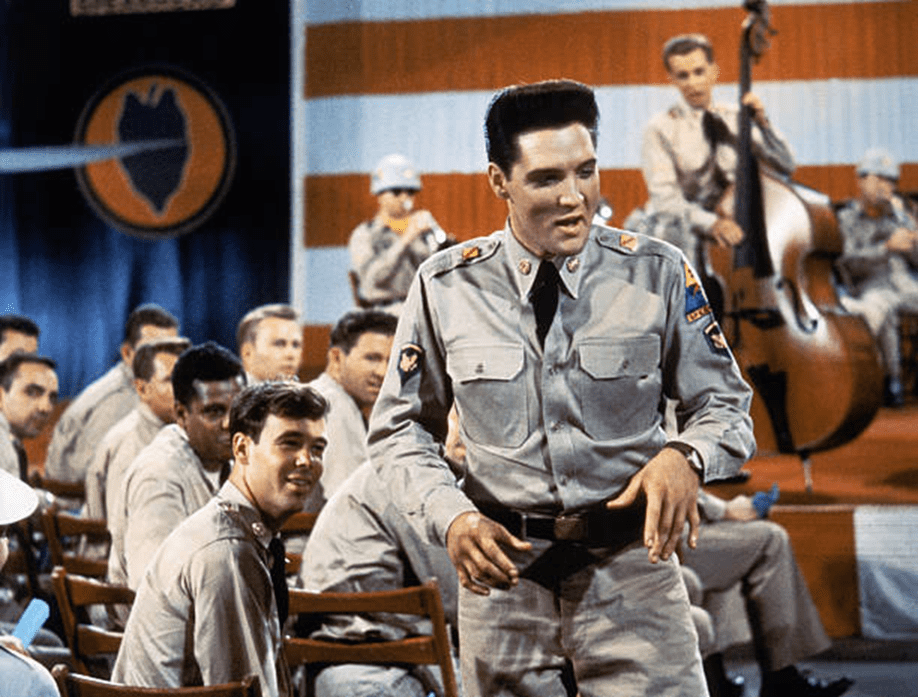
After the Sinatra show, Elvis headed back out to Hollywood to resume his movie career, beginning with “G. I. Blues” in late April.
Some background footage for the movie was shot in Germany in 1959, when producer Hal Wallis visited Elvis, although Elvis did not participate in any of the filming, in keeping with his military service. The leading lady was Juliet Prowse, who was dating Frank Sinatra at the time. Later, Prowse would say that she had an affair with Elvis during the filming. The two were never seen out in public together, with Prowse saying that they would never go out as Elvis was imprisoned by fans. Prowse was twenty-four at the time, and although she did get engaged to Sinatra in 1962, the engagement did not last.
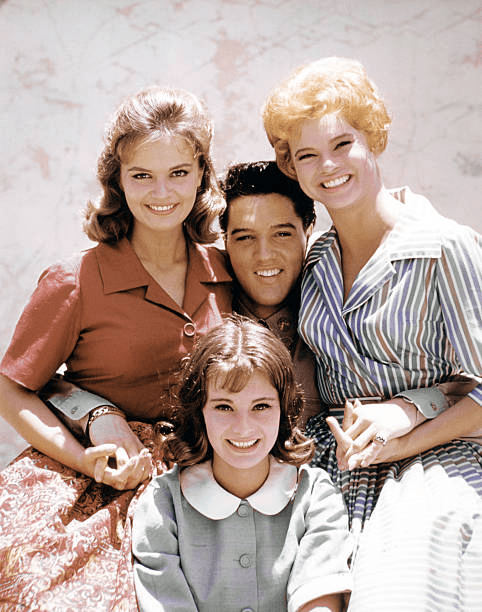
In the film, Prowse plays nightclub dancer Lili, who has a reputation for being unforgiving toward admirers. When Elvis’s character, Tulsa McLean, is press-ganged into taking up a bet to date her and spend the night with her, Tulsa takes the nice, clean, wholesome approach. However, he backs out of the bet because he is not comfortable and genuinely likes Lili. A complication arises when one of Tulsa’s fellow G.I.’s discovers he is a father from a previous encounter and takes time off to get married, leaving Tulsa to babysit. This does not go well, and Tulsa must call on Lili for help. The G.I.’s keeping an eye on the two of them think that Tulsa has won the bet as a result. However, the army Captain finds out about the bet, and the outfit is in deep trouble until Lili spots the baby in a dressing room with his mother ahead of the armed forces show, which she is rehearsing for.
The film contains eleven songs, including a remake of “Blue Suede Shoes”, used during an early barroom brawl scene.
Elvis hates the songs and the movie, saying he felt stupid breaking into song every time he makes a play for some chick. Priscilla said he would call her in Germany and rant about the plot and the songs. Elvis did not care for the light, family entertainment, or romantic-comedy genres. Despite this, the movie was a huge hit and so was the soundtrack album, which comfortably outsold “Elvis Is Back!” and was nominated for two Grammys, “Best Soundtrack Album” and “Best Male Vocal”. The film was also nominated by the Writers Guild of America for “Best Written Musical”.
It was radically lighter than both “Jailhouse Rock” and “King Creole”, but looking back at the time, the same was true of music. Jerry Lee Lewis would comment about the music of the early 1960’s pre-Beatles era, saying that it had become “Bobby this and Bobby that”, referring to the more poppy sound of the likes of Bobby Darin and Bobby Vee.
Despite his own reservations, the movie’s success was in keeping with the time; rock ‘n’ roll had calmed down, at least temporarily.
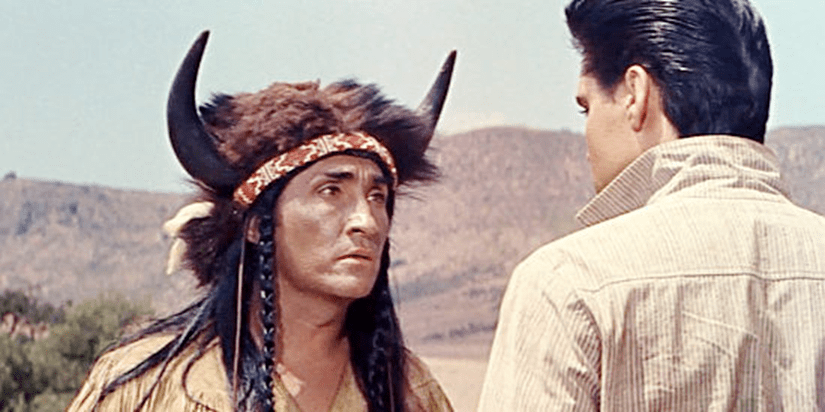
Elvis was much happier with his next film, “Flaming Star”, a dramatic western in which he plays Pacer Burton. Pacer is the son of a Texan rancher and a native Kiowa mother. The Kiowa are unhappy with the increasing claims to land by homesteading Texans and begin raiding various ranches. Pacer’s loyalties are called into question. The Kiowa leader, Buffalo Horn, will guarantee the safety of the Burtons if the Pacer rides with the Kiowa. Pacer has a half-brother, Clint (played by Steve Forrest). The family try to maintain neutrality. This does not work well for either side, and fellow Texans do not want anything to do with the Burtons. When Pacer’s mother, Neddy, is injured, the Texans delay the doctor from attending to her. When Neddy dies, Pacer blames the Texans for his mother’s death and chooses to ride with the Kiowa. However, when Clint is attacked, Pacer comes to his aid and gets fatally injured as a result. Pacer has a vision of the “flaming star of death” and rides off to die alone.
The film had been originally planned for Marlon Brando to play Pacer and either Montgomery Clift or Frank Sinatra to play Clint. The film only has two songs: the theme song “Flaming Star” and “A Cane and a High-Starched Collar” performed early on at a Burton family party.
Elvis receives praise for his acting, and Quentin Tarantino, the future director of the 1994 movie “Pulp Fiction”, described “Flaming Star” as “a truly great ’50s Western, and maybe the most brutally violent American Western of its era.
However, although the film did make a profit, “G.I. Blues” made about five times as much, and it also had a soundtrack album that topped the charts in the US and UK and yielded a number 1 single in the UK with “Wooden Heart”.
The financial figures spoke volumes to Hal Wallis and Colonel Parker.
The comparative success of Elvis’ next two films, “Wild in the Country” and “Blue Hawaii”, would mirror that of “G. I. Blues” and “Flaming Star”, with “Blue Hawaii” performing even better than “G.I. Blues”. This sealed Elvis’ fate in Hollywood, and, with a few exceptions towards the end of his time there, Elvis would make family-oriented, romantic, musical comedies, much to his increasing frustration.