Elvis made Jailhouse Rock while Vernon and Gladys were completing the move to Graceland in May 1957.
Elvis plays Vince Everett, who accidentally kills a man in a bar brawl started when Vince defends a woman from her jealous partner. Vince gets convicted of involuntary manslaughter. When arriving in prison, Vince becomes the cellmate of Hunk Houghton, an ex-country musician who had fallen on tough times and ended up robbing a bank. Vince notices Hunk’s guitar hanging in the cell and shows interest. After singing a simple ballad, “Young and Beautiful”, Hunk takes it upon himself to teach Vince the guitar.
A TV talent show is broadcast from prison as a smoke screen to hide the poor conditions from prison inspectors. Vince sings “I Want to be Free” and, afterwards, receives hundreds of letters that the governor withholds from him. Hunk is aware of the mail, as he works in the prison mail room, and promptly drafts an informal contract with Vince to be equal partners in the music business upon their release from prison.
A riot breaks out in the prison when prisoners complain about the food and conditions, disappointed that inspectors had been hoodwinked by the TV show. Hunk initially stops Vince from joining in and leads him back to their cell. However, a guard lashes out at Vince without cause, and Vince punches him. Vince receives a whipping as punishment. Hunk tries to bribe the prison officers not to carry out the punishment, but he cannot pay the price.
Vince leaves the prison six months before Hunk. He heads for a bar that Hunk recommended on the presumption that he could get a job there singing. When the owner offers him a job as a bar boy, Vince attempts to convince him otherwise by jumping on the stage and singing “Young and Beautiful” in the style Hunk had taught him. It does not go over well, and one customer who engages in his own joke-telling and laughs at his own jokes makes the situation worse. At the end, Vince smashes the guitar on the customer’s table and storms out.
Prior to this, Vince had briefly met Peggy Van Alden, a music agent visiting the bar to check the number of plays recording star Mickey Alba had achieved on the jukebox. She follows Vince out of the bar and challenges him to record himself singing so he can discover why the customers did not listen to him.
Vince takes up the challenge and performs a version of “Don’t Leave Me Now”. Listening to the playback, Vince is not impressed with himself, declaring, “Man, that’s awful.” He makes a second attempt, requesting the band to put a little fire into it. The result is much better, and Peggy and Vince try to sell the recording to record companies, including Geneva Records. The manager rejects the recording but decides to take a copy to play to New York bosses, who also turn the record down. Vince and Peggy eventually sell the recording to a small label. But on release, Peggy and Vince discover that Geneva Records played the recording to Mickey Alba, who copies Vince’s fresh style, ruining their chance.
Vince convinces Peggy that they could start their own record label. When “Treat Me Nice” becomes a hit, Vince is on his way to superstardom. Concerts, a TV special, and movie deals all follow.
Hunk Houghton turns up to see what his “partner” is up to just before Vince records the TV special. Hunk raises the subject of the contract, and Vince must tell Hunk that it is worthless, as it was not drawn up legally. However, he also offers Hunk 10% to function as his roadie, in honour of the whipping Hunk had tried to buy him out of.
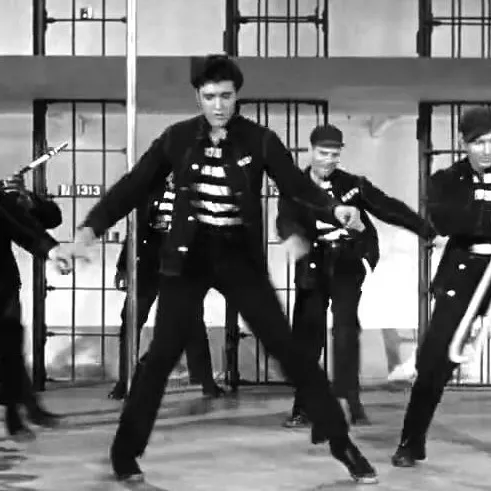
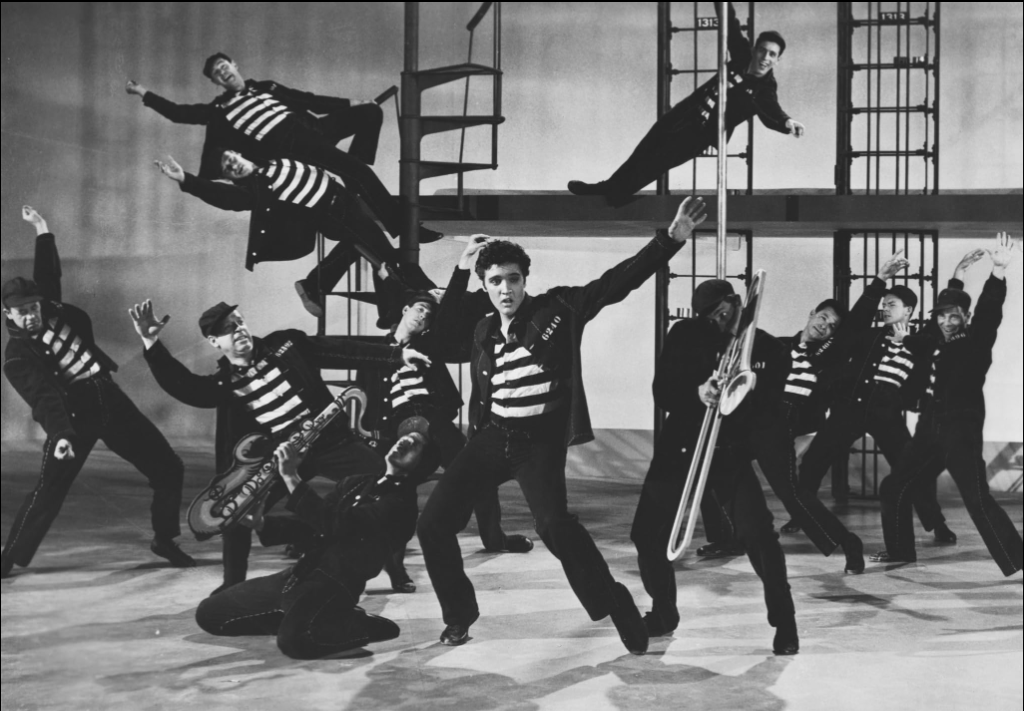
On the TV special, Vince performs “Jailhouse Rock” with a large dance ensemble, swinging on poles and made-up cell doors.
This was the first scene in the movie that Elvis shot. Dancer Alex Romero did the initial choreography. When Elvis rehearsed the scene, he was less than impressed, telling his friend George Klein, “Man, this isn’t me.” George Klein described the choreography as being something more attributable to Gene Kelly or Fred Astaire. Elvis insisted that the choreography be redone to better suit his own style. Fans and critics describe the resulting sequence as the greatest musical moment in all of Elvis’ movies and, of any movie, certainly any rock ‘n’ roll movie. Some music historians describe the scene as being the prototype for the modern music video. “Jailhouse Rock” became one of Elvis’ biggest-selling singles, topping the charts in the US and the UK. In the UK, it was the first single to enter the singles chart at number one in 1958 (the first chart, produced in 1952, was excluded). It also achieved this feat twice: in 2005, a reissue commemorating what would have been Elvis’ 75th birthday repeated the success.
In 1991, the American Society of Composers, Authors, and Publishers (ASCAP) awarded songwriters Jerry Lieber and Mike Stoller the ASCAP Award for the most performed feature film standard.
In the movie, Vince’s universal success appears to go to his head. Things reach a boiling point when Vince’s lawyer and manager advise him that Geneva Records wants to buy the record label he started with Peggy. As the majority partner, Vince agrees, upsetting Peggy, which is the final straw for Hunk. Hunk challenges Vince to a fight, but Vince refuses. Hunk hits him anyway, catching him in the larynx, putting Vince’s career in jeopardy.
In 2004, “Jailhouse Rock” was selected for preservation in the United States National Film Registry, as it was deemed “culturally, historically, or aesthetically significant.”