
Bill Rectangle
Author of “Stenhouse” – Interviewed on 10th September 2026, by J K Mullins
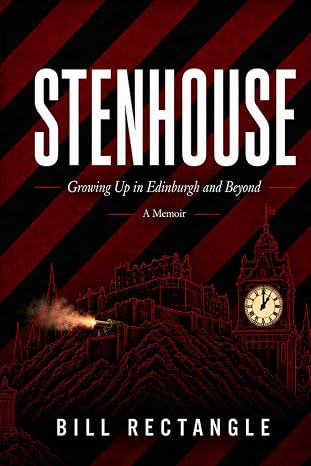
Bill Rectangle is the pen name of Michael Judge. Like me, Bill works in the IT industry and has also turned to self-publishing. His first book, Stenhouse, shares Bill’s memories of growing up around Edinburgh, Scotland. Since we have so much in common, I am sure Bill will contribute more, and he is the latest featured author on The Book Hook Online.

Edinburgh is a beautiful and historic city, regularly visited by
tourists. But what is it like growing up there?
Edinburgh is a wonderful, cosmopolitan city shaped by many cultures,
communities and religions. When you grow up somewhere so beautiful and
historic, however, it is very easy to take it for granted. There were
parks, museums, sport, music, festivals, historic buildings and
opportunities sitting almost outside our doorstep, but as children we
simply accepted them as part of everyday life.
Growing up in Stenhouse also gave me a strong sense of local
community. Edinburgh could feel like a collection of smaller villages,
each with its own character, familiar faces and traditions, while
still being part of a much larger capital city.
It was only after visiting many other cities and countries that I
fully appreciated how fortunate we were. Travelling gave me a much
stronger perspective on Edinburgh’s beauty, history and quality of
life. The city is not perfect, but it remains a remarkable place in
which to have grown up.
Have you stayed close to the city?
Yes, very much so. My father still lives in Edinburgh, where he
remained after we lost my late mother to cancer nearly two decades
ago, and our family visits him regularly. We are also constantly in
and out of the city for work, socialising, shopping, amenities and
football.
My partner and I have lived together for 27 years in the Greater
Edinburgh area of West Lothian, roughly ten minutes west of Edinburgh
Airport. Choosing to live just outside the city gave us much better
value for money when buying our home, while keeping Edinburgh easily
commutable.
We moved into a new-build estate where everyone was new at roughly the
same time, which helped create a particularly friendly community. We
love our home and have built our life there, but Edinburgh has never
stopped feeling close.
The transport links make that possible. We can reach the city by train
in only a couple of stops, and we often use the tram from the
park-and-ride beside Edinburgh Airport. It gives us the best of both
worlds: a strong community and more space outside the city, with
Edinburgh still readily accessible.
How would you say the city has changed in the last 40 years?
Edinburgh has changed enormously. The cost of living and housing has
risen dramatically, pricing many people out of the city and
encouraging further development throughout the surrounding areas. That
growth has created more viable places to live and commute from, but it
has also made the city busier, with heavier traffic and much greater
pressure on parking.
Many changes have been positive. Public spaces have received more
attention, while active-travel initiatives, cycle lanes, the expanded
tram network, the Low Emission Zone and the redevelopment of the St
James Quarter have changed how people move through and experience the
centre.
Saughton Park has undergone one of the most striking local
transformations. Development was continuing there throughout my
childhood, but its later restoration turned it into a beautiful and
valuable community space for Stenhouse and the surrounding districts.
Its gardens and horticultural work have even appeared on BBC’s
Beechgrove.
The development of the Saughton skatepark also means a great deal to
me. When I was a young street skater, we often built our own ramps,
and Bristo Square became one of the main places where Edinburgh
skaters gathered. The skateboard community campaigned for years for a
proper park in the city. Livingston was the closest established
skatepark for many of us, so seeing a major facility eventually
created at Saughton felt like a real achievement for later
generations.
The shopping area around Stenhouse Cross has also been modernised,
with new retail premises and housing. Development brings useful
facilities, but it can also remove familiar landmarks. It was sad to
see older local church buildings disappear as the area changed,
including the original St Aidan’s building on Stenhouse Drive and the
former Baptist church building.
Beyond the immediate neighbourhood, developments such as the
continuing improvements at Hillend Snowsports Centre and Lost Shore
Surf Resort at Ratho show how much the range of sport and leisure
opportunities around Edinburgh has expanded.
The growth in traffic is particularly noticeable to me because of my
IT career. When I first worked in the city, I could occasionally pull
onto a yellow line for a few minutes while I ran into a customer’s
office to repair a computer or network. You could never expect to get
away with that now. It is a small example, but it shows how much
busier and more tightly managed the city has become.
Your book preview indicated that music was a big influence on your
childhood, and you have a diverse musical taste, but how good were you
at dancing like Shaky?
I always loved dancing. Whenever records were playing, my family would
ask me to perform, although I never needed much encouragement. Whether
I was actually any good at dancing like Shaky is probably for other
people to decide, but I certainly believed in what I was doing.
I did a bit of that myself. Although Elvis, is the main man, many Elvis fans were drawn to Shaky, in the 1980s.
Breakdancing became more serious for me when I was around nine or ten.
I could body-pop, perform windmills and do heads pins, so I reached a
fairly good level for my age. I practised in the house, at family
celebrations and anywhere else that gave me enough floor space.
I gradually stopped when the original breakdancing boom began losing
its mainstream momentum and other interests took over. The love of
music and movement never disappeared, though. Music has remained tied
to particular memories, places and periods throughout my life.
What are your musical tastes today?
My musical taste remains broad, although indie and electronic music
probably sit at its centre. I enjoy bands such as Oasis, Kasabian and
The Stone Roses, while also appreciating earlier artists including The
Beatles and Harry Nilsson.
Electronically, I love Kraftwerk, The Chemical Brothers, Underworld,
The Orb and Orbital, along with good old-school house, techno and
acid-house music. Josh Wink and Fluke are other favourites. I have
been fortunate enough to see many of the indie and electronic artists
I have mentioned perform live over the years, and those gigs and
events strengthened my connection to the music.
I also love the records used in the stylish crime and gangster films
that became such a major part of 1990s culture. The soundtracks to
Reservoir Dogs, Pulp Fiction, Jackie Brown and GoodFellas are
particular favourites. Quentin Tarantino had an exceptional ability to
use existing records to give his films their atmosphere and identity,
while Martin Scorsese achieved something equally memorable with the
wall-to-wall music in GoodFellas.
For me, there will only ever be one King, and that will always be the case. But I like others too, including Roy Orbison, Johnny Cash, Shania Twain, Madonna, Meat Loaf, Bon Jovi, and Whitney Houston. I’ve seen Shania, Madonna, Meat Loaf and Bon Jovi in concert.
Like me, you have a career in IT / Software Engineering;
what is your take on the emergence of AI?
I have worked in IT for more than 30 years, progressing from frontline
technical engineering and end-user support into infrastructure
management, cybersecurity, cloud technology, automation, consultancy
and digital-transformation leadership. I am a Microsoft technology
specialist and have held Microsoft Certified Professional status since
2002, alongside my MCSA and MCTS credentials. I am also a professional
member of the BCS – The Chartered Institute for IT.
I consider myself a lifelong learner with a strongly autodidactic and
hands-on approach. Formal qualifications have been important, but much
of my development has also come through independent research,
experimentation and applying technologies in real environments. In IT
and AI, learning cannot stop when a qualification is completed.
After working through a major six-year migration and
digital-transformation programme, I see AI as the next stage in how
technology can assist people and organisations. For around two and a
half years, I have been developing and applying prompt-engineering
skills in professional and personal contexts. At work, I use AI to
assist with automation, coding, cybersecurity, research,
problem-solving and routine tasks. Its output must still be checked,
tested and challenged by someone with the appropriate knowledge.
STENHOUSE was also a personal experiment in using AI creatively while
keeping the human firmly in control. My own lived experience remained
the single source of truth. The book was not created by entering a
short prompt and asking AI to write my life story.
I first wrote and arranged approximately 50,000 to 60,000 words of
memories into a chronological skeleton, covering my earliest childhood
through to leaving school. I then developed what I call the Cinematic
Layering Technique. I approached each memory like a painting:
establishing the basic picture and gradually adding colour,
atmosphere, movement and depth.
Through carefully designed prompts, I instructed AI to ask structured
follow-up questions about each memory. These helped me explore the
setting, sensory details, remembered conversations, emotions and later
reflection. Every layer still came from me. AI helped ask questions,
organise material, refine language and check continuity, but it was
not permitted to manufacture events or decide what my memories meant.
The process produced a completed memoir of 80,837 words across 69
chapters.
AI-assisted tools also supported preparation and checking for the
paperback and Kindle editions, parts of the audiology-production
workflow, promotional copy, website material, newsletters, social
media, advertising scripts, storyboards and visual concepts. I
personally narrated the complete audiobook and remained the author,
publisher, verifier and final creative decision-maker.
I intend to use AI carefully for future age-appropriate adaptations,
original artwork and visual material. As cinematic AI develops, the
memoir and the material I have created could potentially become the
foundation for animated, dramatised or longer-form screen adaptations.
The original work and my lived experiences must remain the
authoritative source.
I therefore see AI as an enabler rather than a hindrance: another tool
in the creative and professional toolbox. However, responsible
governance must keep pace with development. Clear policies are needed
around accountability, privacy, security, accuracy, bias, transparency
and intellectual-property rights. I am strongly opposed to plagiarism
and to established artists having their work or identity exploited
without consent, recognition or fair treatment.
I have written blogs on AI for the site, and the general theme is that AI is an aid to, and not a replacement for, a human. I use
phrases like “humans are the controlling mind” and have “design authority” over AI. Do these ideas match your own?
Yes, completely. Humans must remain the controlling mind and retain
design authority. People must define the purpose, establish the
boundaries, assess the risks and remain accountable for the final
result.
Data quality, ownership, security, governance and organisational
policy should be addressed before an AI system is deployed, not
created afterwards in response to problems. Humans must retain
authority over sensitive decisions involving health, employment,
security, privacy, individual rights and creative ownership.
Artistically, I regard AI as an enabling tool, but I am completely
opposed to plagiarism or to the voices, likenesses and established
work of artists, writers, actors and musicians being copied or
exploited without consent. Protection, licensing, attribution and fair
recognition must form part of responsible policy.
I am also concerned by what I would describe as AI-phobia, where
individual examples are taken out of context and presented to people
who may not understand the technology as though they represent the
entire field. Legitimate concerns should never be dismissed, but the
debate must be informed and evidence-based. We should avoid both blind
enthusiasm and exaggerated fear.
I believe AI could hold one of the keys to humanity’s future,
particularly in healthcare. AI and machine learning have supported
medical imaging, diagnosis, clinical research, disease monitoring and
drug development for years. As these systems advance, they could help
specialists identify illness earlier and analyse complex medical
information, but healthcare professionals and patients must retain
judgement, responsibility and informed choice.
Would you like to tell us about your future plans as an author?
My immediate plans are to explore two age-appropriate adaptations of
STENHOUSE. The present book can resonate with mature secondary-school
readers as well as adults, particularly through its treatment of peer
pressure, friendship, identity and the choices young people face while
growing up.
The first adaptation would be for primary-school children, followed by
a more visual edition for younger P1-P2 readers using shorter
sentences and original artwork. Because the original memoir and source
material are established, these adaptations feel realistically
achievable, although they will still require careful judgement about
language, content and age suitability.
My role extends far beyond authorship. Through White Hat Media, I am
also the independent publisher, project manager and marketer. I
personally manage the book formats, website, campaigns, audiobook
production and wider project development. I narrated the complete
audiobook and have worked as the creative producer and animator of the
project’s promotional films, adverts and visual media.
I would like to make progress on the adaptations towards the end of
2026 and into early 2027, but these are aspirations rather than firm
commitments. My professional IT career and family responsibilities
remain my main priorities. The writing, publishing and multimedia work
is a personal side project that I want to keep fun, artistic and
experimental. I do not want it to become another job governed by rigid
deadlines. Sometimes life simply happens, and I want the freedom to
pause or change direction when necessary.
The response to STENHOUSE has suggested another possibility. Old
friends and family have connected enthusiastically with the book
through my social-media platforms. Their reactions have prompted me to
remember additional moments from the same period, which could
eventually become a collection of short stories set around Stenhouse
and Edinburgh during the 1980s and early 1990s.
Further ahead, I intend to explore a second full-length book beginning
when I was around 16 or 17. It would cover leaving school, entering
employment, attending college, continuing my studies and eventually
beginning my first job in IT.
At that age, my friends and I were part of Edinburgh’s great techno
and rave generation. We did not simply observe that culture – we lived
it, and it felt as though we absolutely rocked Edinburgh and Scotland.
At the same time, we felt connected to the electronic music, clubs and
youth culture spreading throughout the UK and Europe.
When T in the Park first started in 1994, it later became one of
Scotland’s most celebrated festivals, but it seemed almost uncool to
our particular crowd at the time. We identified more strongly with the
underground techno and rave scene and viewed mainstream festival
culture as belonging to a slightly different world. That contrast
shows how strongly young people defined themselves through particular
music scenes.
As the decade progressed, the story would move into the Britpop and
Cool Britannia years. It was an especially heady and eventful era for
me, my close friends and our wider social circles. The music,
nightlife, friendships, ambitions, pressures and occasional chaos
should make this part of the story particularly energetic and
interesting.
Rather than presenting the second book as an entirely factual memoir,
I am considering a transparent hybrid of genuine life stages and
fictionalised storytelling. That would provide greater creative
freedom while making it clear that every character, conversation and
event should not be interpreted as a literal historical record. My
real experiences would remain the foundation, but fictionalisation
would allow a stronger and more adventurous narrative.
I will begin that project when I have the necessary time and creative
space rather than tying it to a fixed publication date. I will
continue experimenting through White Hat Media and remain open to fair
publishing, adaptation or cinematic collaborations, while protecting
the independence, enjoyment and creative freedom at the heart of the
project.
Discover more
- You can find out more about Bill Rectangle on his White Hat Media website https://www.whitehatmedia.org/
- Judge IT Consulting website https://www.judgeitconsulting.org/
- Amazon universal purchase link for Stenhouse.
- Stenhouse short video.
- Stenhouse cinematic video.
Further reading
- Read about my Memories of an Elvis fan.
- My appearance on Blue Peter in 1988.
- My introduction to AI history.